-
The views expressed herein do not constitute research, investment advice or trade recommendations, do not necessarily represent the views of all AB portfolio-management teams and are subject to change over time.
Stewardship Across Generations: A Stronger Model for Japan’s Boards
3 min read
Japanese companies favor seniority, but there may be material benefits to multigenerational boards.
Japan has made major strides in corporate governance over the past decade. Reforms have included increasing board independence and modernizing committee structures. Yet one component of Japanese boards remains relatively unchanged: age. That’s a material oversight, in our view. Corporate boards that are too monolithic could be putting a damper on profits.
Corporate boards in Japan have long been characterized by seniority and continuity against a backdrop of lifetime employment. More than 95% of directors in the TOPIX 100 are in the bubble generation or older, while fewer than 1% are under the age of 50. This level of experience provides stability and institutional knowledge, but it may also entrench decision-making and hinder capital efficiency.
Many boards in Japan prioritize balance sheet safety over returning capital to shareholders and taking calculated risks. This has helped contribute to a more than 10% gap in return on equity (ROE) between Japanese and US equities . In a market long challenged by poor capital allocation, we think multigenerational boards can help buck this trend.
Multigenerational Boards Can Boost Performance
Studies in both the US and Europe present a clear link between multigenerational boards and financial performance. He, Miletkov and Staneva found that companies with younger directors not only generate higher return on assets but also command higher price-to-book values—particularly for firms that invest more in R&D and engage in patenting activity.
Younger boards can also mean less exposure to defaults—and chicanery. Janahi, Millo and Voulgaris discovered that banks with multigenerational boards experience fewer nonperforming loans, while Neukirchen, Posch and Betzer observed less corporate misconduct among firms with a greater age range.
These findings cumulatively suggest that multigenerational boards have the potential to improve capital allocation, reduce risk and boost valuations.
Mind the Gaps: Age and ROE
Our own in-house research confirms these findings. We tracked TOPIX constituents over a 10-year period—the largest study of its kind. The results were striking.
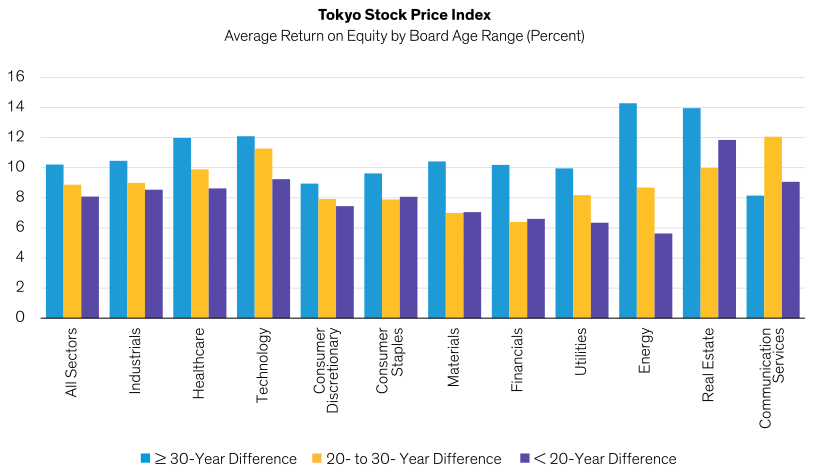
Firms with a more than 30-year age gap between the youngest and oldest director—what we define as multigenerational boards—delivered ROE more than 200 basis points higher, on average, than companies with more senior boards. This outperformance occurred in every calendar year during the period, and the results were statistically significant across sectors. Multigenerational boards achieved superior ROE in all but one sector, with the dispersion independent of size, style or founder-led status (Display).
Multigenerational Japanese Boards Have Historically Generated Stronger Returns
Historical analysis does not guarantee future results.
ROE values are winsorized at the 1st and 99th percentiles within each year to mitigate the influence of extreme values. The sample consists of 14,836 firm‑year observations.
January 1, 2016, through December 31, 2025
Source: Bloomberg, Japan Exchange Group and AllianceBernstein (AB)
Why the improved performance under multigenerational boards? We theorize that younger directors counterbalance the risk-averse tendencies of more senior directors. Prior academic research shows that younger boards exhibit greater risk tolerance, on average, than their senior counterparts. This is reflected in increased M&A activity and lower cash balances.
Of course, experience and qualifications remain critically important to board appointments. We favor a balanced approach that preserves legacy institutional knowledge while opening the door to next-generation dynamism.
What does this look like in practice?
Hello Kitty’s Generational Glow-Up
The Japanese company behind the popular Hello Kitty brand, has long held a rich portfolio of valuable intellectual property. But historically, its business model focused largely on domestic merchandise sales. The company maintained consistent leadership for many decades under its founder, Shintaro Tsuji, which contributed to stability but slowed strategy development. As market conditions evolved and retail trends shifted, the company’s merchandise business came under pressure, and it recorded a loss in fiscal year 2020.
Recognizing the need to adapt, the 92-year-old Tsuji turned leadership of the company over to his 31-year-old grandson but remained on the board. The young new president initiated sweeping reforms by refreshing the board and management, overhauling retail operations, and recruiting external talent with diverse backgrounds.
The company also expanded its international footprint and leveraged social media and streaming services to amplify its brand. These changes unlocked the global potential of the firm’s character portfolio and repositioned it as an entertainment-focused intellectual-property enterprise, rather than a traditional retailer.
The effect on operating profit and ROE has been dramatic. The company now expects operating profit of ¥75.1 billion in FY 2025—more than triple its previous peak of ¥21 billion in FY 2013. Moreover, its stock price has increased tenfold, reflecting renewed investor confidence in its strategy and earnings potential.
The company's transformation illustrates how a fresh generational perspective can address underlying issues hindering shareholder returns. In our view, if properly implemented, multigenerational boards can unlock organizational agility, greater independence and new pathways for value creation. In an era of rapid market and technological change, we believe boards that balance experience with fresh perspectives can be catalysts for building shareholder value.
The authors would like to thank Landon Shea, Investment Stewardship Associate and Research Lead, for his contribution to this piece.
-
References to specific securities discussed are for illustrative purposes only and should not to be considered recommendations by AllianceBernstein L.P. It should not be assumed that investments in the securities mentioned have necessarily been or will necessarily be profitable.
-
Investment involves risk. The information contained here reflects the views of AllianceBernstein L.P. or its affiliates and sources it believes are reliable as of the date of this publication. AllianceBernstein L.P. makes no representations or warranties concerning the accuracy of any data. There is no guarantee that any projection, forecast or opinion in this material will be realized. Past performance does not guarantee future results. The views expressed here may change at any time after the date of this publication. This article is for informational purposes only and does not constitute investment advice. AllianceBernstein L.P. does not provide tax, legal or accounting advice. It does not take an investor's personal investment objectives or financial situation into account; investors should discuss their individual circumstances with appropriate professionals before making any decisions. This information should not be construed as sales or marketing material or an offer of solicitation for the purchase or sale of, any financial instrument, product or service sponsored by AllianceBernstein or its affiliates. This presentation is issued by AllianceBernstein Hong Kong Limited (聯博香港有限公司) and has not been reviewed by the Securities and Futures Commission.