-
The views expressed herein do not constitute research, investment advice or trade recommendations, do not necessarily represent the views of all AB portfolio-management teams and are subject to change over time.
High-Yield Opportunity Persists, Despite Tight Spreads
3 min read
High-yield investors put off by today’s narrow spreads could be missing out.
With high-yield credit spreads hovering near all-time lows, some investors may be tempted to sit on the sidelines until spreads have widened before investing. We think that could be a mistake. In fact, we see a compelling case for investing in the high-yield market today, despite narrow spreads. Here’s why.
1. Spreads Are Tight Because of Good News
The biggest reason that spreads are so narrow today is that economic news has been good. Sustained economic growth has made the possibility of recession seem more remote. Strong fundamentals also play a role, as companies have fortified their balance sheets and locked in lower interest expenses in the years since the COVID-19 pandemic. As a result, defaults have been modest, running below their historical averages—and below Street expectations.
Meanwhile, attractive yields have stoked demand in the global high-yield market as investors try to capitalize on higher potential returns and lower perceived risks. By contrast, on the supply front, companies have focused more on reducing debt than on using it for growth or acquisitions. As a result, demand has been outstripping supply, creating a favorable technical backdrop that supports prices and keeps spreads tight.
Debt reduction has also caused the average maturity of the Bloomberg US Corporate High Yield Index to shorten to record lows (Display). Consequently, both the index’s average duration and its “spread duration”—the sector’s price sensitivity to changes in spread levels—are below historical averages.
The High-Yield Market’s Average Maturity Has Shortened Dramatically
Bloomberg US Corporate High Yield Index: Average Maturity (Years)

Historical analysis does not guarantee future results.
Through August 29, 2024
Source: Bloomberg
2. Tight Spreads Have Tended to Be “Sticky”
If history is a guide, high-yield spreads could stay in their current range for some time. Since the mid-90s, tight spreads have remained tight for more than two years, on average (Display).
On Average, Spreads Have Remained Tight for 28 Months
Bloomberg US Corporate High Yield Index: Spread (Basis Points)
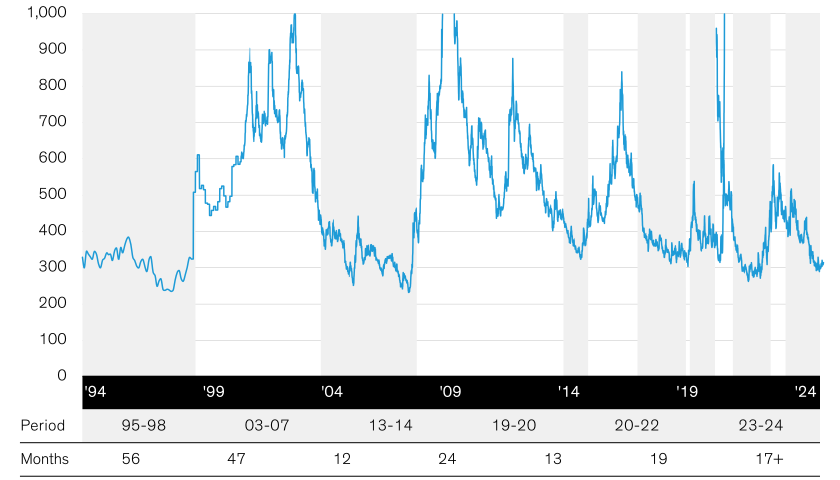
Historical analysis does not guarantee future results.
Highlighted periods begin when spreads fall below 400 bps and end when spreads rise above the long-term average spread of 517 bps.
Through June 30, 2024
Source: Bloomberg and AllianceBernstein (AB)
That’s a long time for sidelined investors to pass up attractive income and return potential. Even a patient investor may find they’ve waited for nothing. (And on those occasions when spreads do blow out, not many investors feel comfortable adding risk when spreads are exceptionally wide, indicating a risk-off environment.)
Further, since 1994, when spreads ranged between 300 and 400 basis points, ensuing returns were strong, averaging roughly 6.6% (Display). In our analysis, that’s because macro factors and overall yield levels hold more sway than spreads.
Narrow Spreads Haven’t Always Translated into Low Returns
Bloomberg US Corporate High Yield Index: Average One-Year Forward Return by Spread Bucket
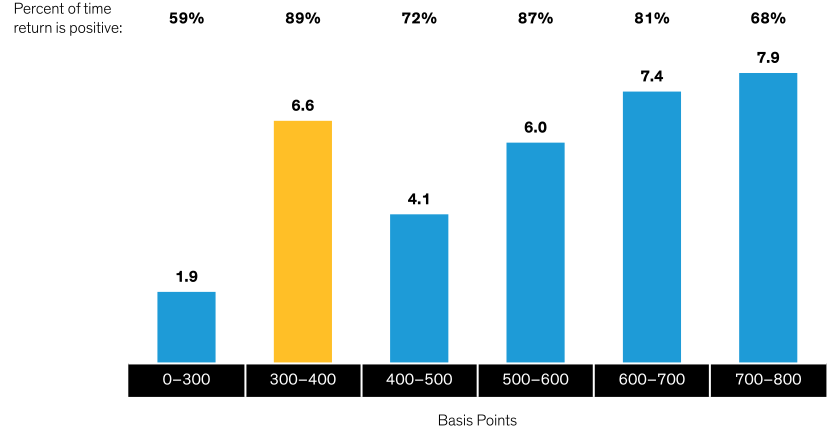
Historical analysis does not guarantee future results.
Spreads are option adjusted.
January 1994 through June 30, 2024
Source: Bloomberg and AB
3. Yields Are Compellingly High
While spreads are relatively low, yields on high-yield bonds are higher than they’ve been in years. And historically, yield has been a much better predictor of return than spread has been. History shows that the sector’s yield to worst has been an excellent proxy for return over the next three to five years, in all kinds of markets (Display). With today’s yield to worst at 7.3%, the potential return appears sizable.
Yield to Worst Has Historically Been a Strong Predictor of Future Returns
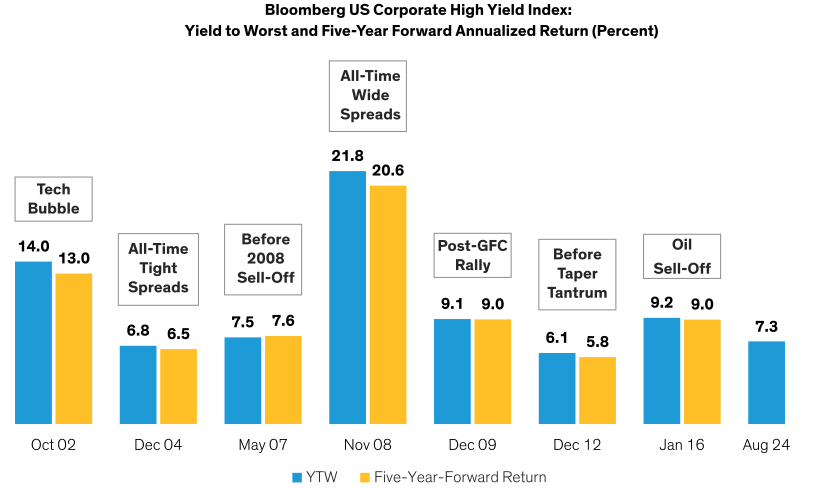
Past performance and current analysis do not guarantee future results.
YTW: yield to worst; GFC: global financial crisis
As of August 31, 2024
Source: Bloomberg and AB
When It Comes to Risk, Context Matters
Some investors may nonetheless be leery of potential spread widening. Because spread widening typically occurs during market corrections and in risk-off environments, it’s important to consider risk-taking in the context of the larger portfolio. That’s especially the case for investors who are overweight equities but underweight credit.
Historically, high yield has delivered equity-like returns with roughly half the volatility. During major sell-offs such as the dot-com crash, the global financial crisis and the COVID-19 pandemic, equity returns declined more sharply than high-yield returns, and high-yield recovered more quickly (Display). In our view, that makes high-yield bonds a prudent substitute for a portion of an equity allocation.
High Yield Has Outperformed Equities During Major Sell-Offs
Total Return (Percent)

Historical analysis does not guarantee future results.
High yield is represented by the Bloomberg US Corporate High Yield Index; equities are represented by the S&P 500.
As of August 31, 2024
Source: Bloomberg, S&P and AB
Of course, spreads may move in either direction, not just wider. Though GDP growth is slowing, we continue to view a recession as unlikely, given the economy’s underlying strength coming into the policy cycle. If the Federal Reserve successfully avoids a recession, it’s possible that spreads could tighten even further, giving a near-term boost to the high-yield market.
Regardless, positive economic news, strong fundamentals, sticky spread trends and compelling yield levels make it, in our view, worth giving a green light to investing in high yield today.
-
Investment involves risk. The information contained here reflects the views of AllianceBernstein L.P. or its affiliates and sources it believes are reliable as of the date of this publication. AllianceBernstein L.P. makes no representations or warranties concerning the accuracy of any data. There is no guarantee that any projection, forecast or opinion in this material will be realized. Past performance does not guarantee future results. The views expressed here may change at any time after the date of this publication. This article is for informational purposes only and does not constitute investment advice. AllianceBernstein L.P. does not provide tax, legal or accounting advice. It does not take an investor's personal investment objectives or financial situation into account; investors should discuss their individual circumstances with appropriate professionals before making any decisions. This information should not be construed as sales or marketing material or an offer of solicitation for the purchase or sale of, any financial instrument, product or service sponsored by AllianceBernstein or its affiliates. This presentation is issued by AllianceBernstein Hong Kong Limited (聯博香港有限公司) and has not been reviewed by the Securities and Futures Commission.