-
The views expressed herein do not constitute research, investment advice or trade recommendations, do not necessarily represent the views of all AB portfolio-management teams and are subject to change over time.
AI Ethics and Regulation: How Investors Can Navigate the Maze
5 min read
From brand risks to regulatory uncertainty, AI poses investment challenges. Is there a way forward?
Artificial intelligence (AI) poses many ethical issues that may translate into risks for consumers, companies and investors. AI regulation, which is developing unevenly across jurisdictions, adds to the uncertainty. The key for investors, in our view, is to focus on transparency and explainability.
The ethical issues and risks of AI begin with the developers who create the technology. From there, they flow to the developers’ clients—companies that integrate AI into their businesses—and on to consumers and society more broadly. Through their holdings in AI developers and companies that use AI, investors are exposed to both ends of the risk chain.
Diverging Rules Shape AI Risk
AI continues to develop briskly, far ahead of most people’s understanding of it. Among those trying to keep up are global regulators and lawmakers, whose activity has recently surged. Many countries have released national AI strategies, and several major jurisdictions have moved from strategy to enforceable rules (Display).
Global Development of AI Policies and Regulation

Historical and current analyses do not guarantee future results.
Through December 31, 2025
Source: AI, Algorithmic and Automation Incidents and Controversies (AIAAIC) Repository; and Sha Sajadieh et al., The AI Index 2026 Annual Report, AI Index Steering Committee, Institute for Human-Centered AI, Stanford University, Stanford, CA, April 2026
The lack of a uniform approach to AI regulation across jurisdictions creates complexities for international businesses. Regulatory approaches differ in form and scope. The European Union’s (EU) Artificial Intelligence Act adopts a risk-based model, with strict requirements for high-risk AI systems. The US takes a sector-specific approach that emphasizes innovation and competitiveness. China prioritizes state control, data sovereignty and comprehensive monitoring.
This regulatory landscape requires internationally operating businesses to monitor developments closely—and compounds AI’s other risks for investors.
Data Risks Can Damage Brands
In business, AI is often deployed through generative tools—such as text, video and voice generation—and large language models (LLMs). LLMs underpin applications such as chatbots, automated content creation and large-scale data analysis.
Many companies have found that AI innovations may involve potentially brand-damaging risks. These can arise from biases inherent in the data on which LLMs are trained and have resulted in banks inadvertently discriminating against minorities in granting home-loan approvals, and in a US health insurance provider facing a class-action lawsuit alleging that its use of an AI algorithm caused extended-care claims for elderly patients to be wrongfully denied.
Risks also stem from AI training data. In September 2025, Anthropic settled a class action over pirated training data for about $1.5 billion. By year-end, more than 70 generative AI copyright lawsuits had been filed, including The New York Times v. OpenAI and Microsoft, Disney and Universal v. Midjourney, and Getty Images v. Stability AI. AI training data risk is increasingly a quantifiable balance-sheet risk.
Bias, discrimination and training data are key regulatory risks that should be on investors’ radars; others include intellectual property rights and privacy considerations concerning data. Risk-mitigation measures—such as developer testing of the performance, accuracy and robustness of AI models, and providing companies with transparency and support in implementing AI solutions—should also be scrutinized.
Dive Deep to Understand AI Regulations
Regulatory approaches to AI are diverging in ways that matter for investors. The EU’s AI Act, a comprehensive, risk-based framework, has been rolling out in phases since 2024. The US, by contrast, relies on existing federal agencies, voluntary frameworks and state-level laws rather than a single overarching regime. The UK has taken a principles-based approach, deferring comprehensive legislation. And China has moved quickly with targeted rules focused on specific applications—particularly those tied to content control, social stability and data sovereignty.
For investors, this divergence has real implications. It is increasingly relevant to ask which jurisdiction a portfolio company is effectively optimizing for, as the rules governing a global business may vary materially by market.
Investors, in our view, should do more than drill down into jurisdiction-specific AI regulations. They should also understand how existing legal frameworks—such as copyright law to address data infringements and employment legislation where AI has an impact on labor markets—are being applied to AI.
Fundamental Analysis and Engagement Are Key
A useful rule of thumb for investors assessing AI risk is that companies that proactively disclose their AI strategies and policies are likely to be better prepared for new regulations. More generally, fundamental analysis and issuer engagement are central to this area of research.
As we see it, fundamental analysis should examine not only company-level AI risks but also risks along the business chain and across the regulatory environment, testing insights against core responsible-AI principles (Display).
Using AI Responsibly: An All-Around View for Investors
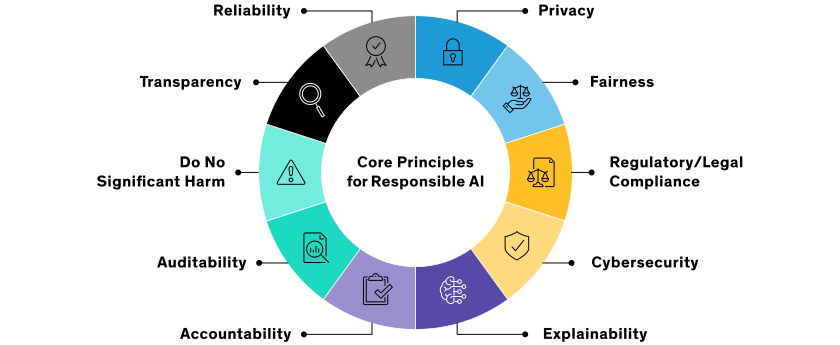
For illustrative purposes only.
Source: AllianceBernstein (AB)
Engagement conversations should address AI issues not only in business operations but also from environmental, social and governance perspectives.
AI Oversight: Questions for Boards and Management
Questions for investors to ask boards and management include:
- AI integration: How has the company integrated AI into its overall business strategy? What are some specific examples of AI applications within the company?
- Board oversight and expertise: How does the board ensure it has sufficient expertise to effectively oversee the company’s AI strategy and implementation? Are there any specific training programs or initiatives in place?
- Public commitment to responsible AI: Has the company published a formal policy or framework on responsible AI? How does this policy align with industry standards, ethical AI considerations and AI regulation?
- Proactive transparency: Does the company have any proactive transparency measures in place to withstand future regulatory implications?
- Risk management and accountability: What risk management processes does the company have in place to identify and mitigate AI-related risks? Is there delegated responsibility for overseeing these risks?
- Data challenges in LLMs: How does the company address privacy and copyright challenges associated with the input data used to train LLMs? What measures are in place to ensure input data is compliant with privacy regulations and copyright laws? How does the company handle restrictions or requirements related to input data?
- Bias and fairness challenge in generative AI systems: What steps does the company take to prevent and/or mitigate biased or unfair outcomes from its AI systems? How does the company ensure that the output of any generative AI systems used are fair, unbiased and do not perpetuate discrimination or harm to any individual or group?
- Jurisdictional compliance: Does the company comply to the highest global standard by default, or jurisdiction by jurisdiction?
- Incident tracking and reporting: How does the company track and report on incidents related to its development or use of AI, and what mechanisms are in place for addressing and learning from these incidents?
- Metrics and reporting: What metrics does the company use to measure the performance and impact of its AI systems? How are these metrics reported to external stakeholders? How does the company maintain due diligence in monitoring the regulatory compliance of its AI applications?
Ultimately, the best way through the maze is for investors to stay grounded and skeptical. They should insist on clear answers—and not be unduly impressed by elaborate explanations.
-
Investment involves risk. The information contained here reflects the views of AllianceBernstein L.P. or its affiliates and sources it believes are reliable as of the date of this publication. AllianceBernstein L.P. makes no representations or warranties concerning the accuracy of any data. There is no guarantee that any projection, forecast or opinion in this material will be realized. Past performance does not guarantee future results. The views expressed here may change at any time after the date of this publication. This article is for informational purposes only and does not constitute investment advice. AllianceBernstein L.P. does not provide tax, legal or accounting advice. It does not take an investor's personal investment objectives or financial situation into account; investors should discuss their individual circumstances with appropriate professionals before making any decisions. This information should not be construed as sales or marketing material or an offer of solicitation for the purchase or sale of, any financial instrument, product or service sponsored by AllianceBernstein or its affiliates. This presentation is issued by AllianceBernstein Hong Kong Limited (聯博香港有限公司) and has not been reviewed by the Securities and Futures Commission.