-
The views expressed herein do not constitute research, investment advice or trade recommendations, do not necessarily represent the views of all AB portfolio-management teams and are subject to change over time.
AI and Alpha: Why Technology Alone Won’t Be Enough
5 min read
AI may be the next big alpha engine—but access alone won’t create a lasting edge.
Artificial intelligence is a transformative new technology, but we believe that it’s likely to follow a familiar pattern. From spreadsheets to the internet, innovations have historically given early adopters an edge—for a time. In our view, the ability to maintain that advantage depends much more on how effectively an asset manager integrates it throughout the organization.
Historically, Greater Adoption Has Eroded Innovation Advantages
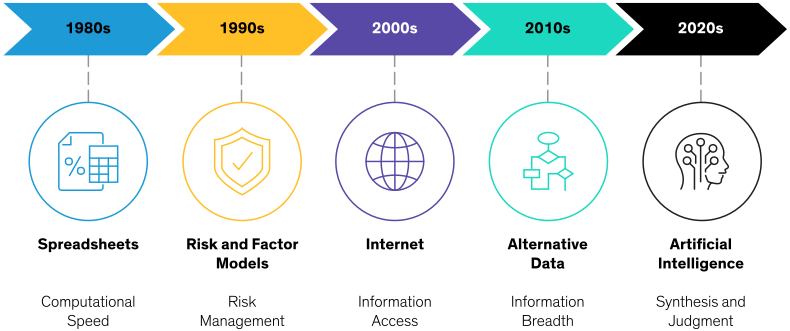
Over the past 40 years, disruptive technology waves have provided early enthusiasts with a powerful but relatively short-lived edge (Display). In the 1980s, spreadsheets gave investors unprecedented computational prowess. Calculations that once required hours of manual entry could be completed in mere minutes using applications like Lotus 1-2-3 and Excel.
Later, advanced risk modeling, such as Value at Risk, enabled investment firms to better measure, quantify and manage exposures. The internet upended the world in the late 1990s and early 2000s. With a couple keystrokes and the flick of a mouse, investors could uncover a staggering breadth of information. In the 2010s, alternative data expanded the information set yet again—yielding insights not yet incorporated in market prices.
But these breakthroughs eventually caught on broadly, eroding any proprietary advantage. When only a handful of firms possess a new capability, they can use it to generate differentiated insights. As adoption spreads, however, any advantage is eventually priced away. An exciting new capability becomes expected—a staple of the investment toolkit.
Technology Has Created Short-Lived Competitive Edges
For illustrative purposes only
Source: AllianceBernstein (AB)
As AI Spreads Broadly, Investment Toolkits Will Likely Converge
We’re now in the throes of another technological revolution with AI and its infrastructure buildout. AI spending could exceed $1 trillion by 2029, and that’s for good reason, given its enormous potential. Currently, AI is giving early adopters two distinct advantages: increased decision-making capabilities and heightened productivity.
For investment managers, that may mean better-informed investment decisions, more effective risk management and potentially better client outcomes. Generative AI is enhancing both judgment and productivity. For example, it’s helping teams streamline data pulled from ever-larger datasets and stress-test theses faster. AI agents are analyzing quarterly earnings transcripts to score management teams and distilling dense regulatory information to illuminate changes in capital requirements.
But even as AI’s capabilities grow, it’s already widely available, so there’s little reason for us to believe that it will forge a different path than previous technology waves. Over time, deploying a generative AI model or AI agents may be no more distinctive than crunching data on a spreadsheet or conducting online research.
How Can Active Managers Create a More Enduring Advantage with AI?
Near-ubiquitous access to AI’s toolkit will present a quandary for active managers. With the same tools at their disposal, how can active managers generate alpha—returns in excess of market benchmarks?
The way we see it, lasting advantages won’t come from models themselves but from the capabilities organizations build around them. AI is evolving quickly, but it takes time to deeply integrate AI tools. We believe sustainable alpha will require embedding AI into robust, repeatable processes—not just bolting it on. For investment managers, that could include allocating decision rights between analysts, portfolio managers and the model itself while incorporating human-led audits of AI-assisted outputs. And as tools advance, active managers must continually fine-tune models to deliver actionable insights.
We believe this is where the more durable advantage lies. Every analyst correction, every rejected output and every instance of a model’s conclusion diverging from house judgment can be fed back into prompts and retrieval systems for fine-tuning. Firms that capture this feedback systematically and govern it with the same discipline as any other investment process build a capability tied to their own analysts. Competitors can license the same model; they can’t license another firm’s accumulated record of correction.
But all these efforts need to be guided by a robust, clearly defined AI strategy. The key is aligning the model with an organization’s investment process and philosophy—training it to help analysts and portfolio managers make decisions consistent with the company’s philosophy. And while AI holds enormous promise, organizations must use it ethically and transparently by establishing strong controls and accountability measures.
We believe sustainable alpha will require fusing technological innovation with enduring human principles of intuition and sound judgment. It will be incumbent on an organization to engrain AI-powered processes into workflows, but the technology alone won’t be enough. Machines won’t replace humans but complement them. Over time, we envision an “iron person” model: investors empowered by extensive AI capabilities outperforming humans—and technology—working on their own.
-
Investment involves risk. The information contained here reflects the views of AllianceBernstein L.P. or its affiliates and sources it believes are reliable as of the date of this publication. AllianceBernstein L.P. makes no representations or warranties concerning the accuracy of any data. There is no guarantee that any projection, forecast or opinion in this material will be realized. Past performance does not guarantee future results. The views expressed here may change at any time after the date of this publication. This article is for informational purposes only and does not constitute investment advice. AllianceBernstein L.P. does not provide tax, legal or accounting advice. It does not take an investor's personal investment objectives or financial situation into account; investors should discuss their individual circumstances with appropriate professionals before making any decisions. This information should not be construed as sales or marketing material or an offer of solicitation for the purchase or sale of, any financial instrument, product or service sponsored by AllianceBernstein or its affiliates. This presentation is issued by AllianceBernstein Hong Kong Limited (聯博香港有限公司) and has not been reviewed by the Securities and Futures Commission.