-
The views expressed herein do not constitute research, investment advice or trade recommendations, do not necessarily represent the views of all AB portfolio-management teams and are subject to change over time.
Why Systematic Fixed Income Requires Wide-Ranging Expertise
3 min read
Factors are just one component of an effective systematic process.
Systematic approaches are gaining traction with investors. In these strategies, a model-driven process drives the investment decisions, using predictive factors with demonstrable links to outperformance. A quantitative decision engine scores and ranks every bond based on its alignment with these factors to generate alpha through security selection. But to be most effective, systematic strategies need to access broader capabilities and expertise.
A Breakthrough in Fixed Income
Systematic strategies appeared first in equity markets and are now gaining popularity in bond markets. The attraction? Systematic fixed-income strategies offer a differentiated approach from traditional discretionary management—one that has the potential to generate attractive returns with different performance patterns and more consistent returns.
By contrast with traditional discretionary approaches, systematic fixed-income models are exclusively data-driven and operate autonomously—ranking securities, constructing optimized portfolios and managing risk without traditional inputs or discretionary overlays.
While this autonomous process is the engine of systematic fixed-income investing, the drive chain is execution and implementation technology, while input from experienced investment professionals from a range of backgrounds and specialties helps lubricate the machinery. We believe that integrating these broader resources may enhance research and execution, strengthen risk management and deliver improved outcomes.
Digital Processes Increase Speed and Accuracy
Systematic processes center on scoring each security in the investable universe based on its sensitivity to various factors. Ideally, scoring should be one component in a streamlined, digitized investment process that integrates tools for research, factor testing, market liquidity assessment, optimization and trade execution.
Such integrated approaches enable several key features of strong systematic processes: for instance, more robust factor testing that features transaction-cost-aware simulations and allows for custom optimizations. A digital platform also enables continuous monitoring of factor exposures, concentrations and liquidity metrics to keep portfolios aligned with risk targets. And it can facilitate seamless factor testing, back-testing and rapid deployment of model improvements that can keep systematic strategies adaptive and cutting-edge.
Integrated access to liquidity data is particularly important for translating models into actual portfolios quickly and cost-effectively. For example, advanced liquidity and trading technology can aggregate fragmented corporate bond market data to deliver real-time liquidity intelligence faster and more comprehensively than third-party analytics (Display). This helps reduce transaction costs and improve execution timing, and feeds back into portfolio construction to make for readily implementable portfolios.
Liquidity: Greater Visibility Creates Better Opportunities
Third Party Scoring vs. Proprietary Liquidity Analytics (Percentage of Market)
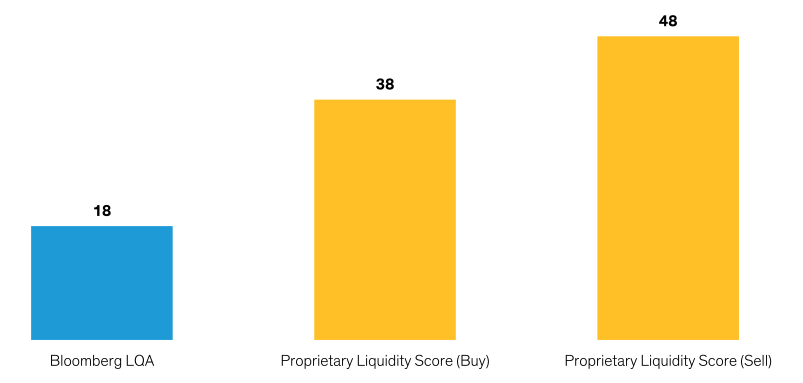
Past performance does not guarantee future results. For illustrative purposes only
LQA: Bloomberg’s Liquidity Assessment Solution tool
Proprietary liquidity analytics: AB Automated Liquidity and Filtering Analytics (ALFA) tool
As of September 30, 2024
Source: Bloomberg and AllianceBernstein (AB)
An advanced trading platform also enables efficient implementation across government, credit, municipal and global markets—an important advantage, as systematic strategies often seek to capitalize on relative value opportunities across fixed-income sectors.
Finally, it can facilitate strong market relationships that provide systematic strategies with new-issue allocations, offering critical liquidity and alpha opportunities.
Wider Expertise Can Help Improve Factor Design
Beyond the advantages of a high-tech fixed-income platform, systematic strategies benefit from access to a broad range of investment expertise. Designing an effective factor can be like solving a complex problem and requires experience and insight.
For instance, as part of a collaborative dialogue, a skilled discretionary portfolio manager with a background in global credit markets might help solve for currency timing to enable a cross-currency factor. Currency timing involves comparing bonds issued by the same global companies but denominated in different currencies. This comparison allows fixed-income managers to tilt their portfolios to bonds denominated in the currencies that offer more attractive spreads. Systematic managers can take this type of insight to create factors that are both effective and scalable.
Experienced credit analysts may also provide insights that can lead to improved factor design or the development of new factors.
Take “spread per turn of leverage,” an established relative-value factor that compares bonds’ credit spreads with their issuers’ cash flows versus borrowings. Experienced credit analysts can indicate the sectors where spread per turn of leverage is likely to be either effective or unreliable and suggest how the factor might be modified to allow for different business models.
For example, for a motor parts manufacturer, stable cash flows are a key element in evaluating creditworthiness. In banking and insurance, however, variable income streams from derivatives and other mark-to-market instruments can result in uneven cash flows. In these cases, balance sheet metrics may be more important. Specialist subsectors like property and casualty insurance may need even more industry-specific metrics. These insights can then be tested and, if they prove effective, incorporated into the systematic model.
Custom Mandates May Need Expert Input
Creating customized investment strategies that address specific client needs is easy with systematic fixed-income approaches. Systematic managers can readily simulate custom portfolio behavior, manage against any benchmark and explain performance to underlying factor exposures and other return drivers.
However, selecting the most appropriate benchmark can be more complex—particularly for portfolios targeting specific environmental, social and governance (ESG) objectives, such as carbon-intensity goals. Responsible investing specialists can provide critical input in these cases, both to ensure benchmarks align with stated objectives and to inform the design of ESG-related factors, such as measures of carbon intensity, governance quality or exposure to controversies.
Integrating Broader Resources May Improve Outcomes
In our view, access to advanced technology and to a deep bench of fixed-income experts has multiple advantages for investors, including:
- Lower transaction costs, thanks to trading synergies and liquidity intelligence
- More stable factor exposures and fewer unintended risks
- Consistent portfolio quality, even as the number of accounts and assets under management grow—because systematic methods scale effectively without diluting discipline or risk controls.
The Future of Systematic Fixed Income
We believe that systematic approaches have proved their worth in fixed-income markets. We see the next steps for leading managers as continuous process improvements that further integrate technology and expert insights to help maximize expected returns.
-
Investment involves risk. The information contained here reflects the views of AllianceBernstein L.P. or its affiliates and sources it believes are reliable as of the date of this publication. AllianceBernstein L.P. makes no representations or warranties concerning the accuracy of any data. There is no guarantee that any projection, forecast or opinion in this material will be realized. Past performance does not guarantee future results. The views expressed here may change at any time after the date of this publication. This article is for informational purposes only and does not constitute investment advice. AllianceBernstein L.P. does not provide tax, legal or accounting advice. It does not take an investor's personal investment objectives or financial situation into account; investors should discuss their individual circumstances with appropriate professionals before making any decisions. This information should not be construed as sales or marketing material or an offer of solicitation for the purchase or sale of, any financial instrument, product or service sponsored by AllianceBernstein or its affiliates. This presentation is issued by AllianceBernstein Hong Kong Limited (聯博香港有限公司) and has not been reviewed by the Securities and Futures Commission.