-
The views expressed herein do not constitute research, investment advice or trade recommendations, do not necessarily represent the views of all AB portfolio-management teams and are subject to change over time.
Value Investing in Volatile Times: Strategies for a Shifting Landscape
4 min read
Finding attractively valued stocks that can overcome evolving conditions requires a new mindset.
Market uncertainty often creates classic value-investing controversies. This year, sweeping US policy change has shaken the macroeconomic outlook and raised hurdles for many companies. So how can value investors find stocks with recovery potential when it’s hard to predict the next disruptive shock?
The hunt for value isn’t easy these days. While the S&P 500 touched record highs in August, investors remain fearful about the impact of tariffs on economic growth and corporate earnings. Extreme volatility in early 2025 highlighted the extraordinarily fragile market sentiment.
Navigating a Year of Acute Controversy
This environment has all the hallmarks of a value opportunity. Traditional value opportunities are formed when a stock trades below its intrinsic value, often because investors lose confidence in its business prospects because of a controversy. When markets overreact to troubles in a company or industry, it frequently sets the stage for a potential recovery.
Investors understandably have real anxiety about how businesses will manage through changing trade and macro conditions. Yet some companies are better equipped to cope than perceived.
Recognize What Is Researchable
Policy uncertainty is making the investing challenges of 2025 particularly testing. So what can equity investors do?
The first step is to identify what can be researched—and what cannot. It’s ineffective to try and predict what tariff levels will ultimately be imposed on different countries or products. Similarly, efforts to forecast inflation, interest rates and GDP growth trends in such a fluid environment won’t help us find companies that can surmount new challenges. Instead, we believe investors should focus on company-specific issues that are researchable—regardless of the policy clouds—such as:
- Companies undergoing positive change: Share prices may fall hard when a company falls on hard times. But businesses that change for the better often aren’t recognized until their stock catches up.
- Sustainable competitive advantages are always a good driver of earnings growth that can withstand near-term challenges.
- Strong or improving industry dynamics: Think about the healthcare industry, which faces severe policy uncertainty. However, the pace of long-term R&D spending is still likely to remain above GDP growth. That means select healthcare companies can buck the negativity over the long term. Agriculture equipment is another industry with subpar earnings growth, though its long-term productivity enhancements should fuel industry growth that is poised to outpace GDP growth.
A New Value Universe
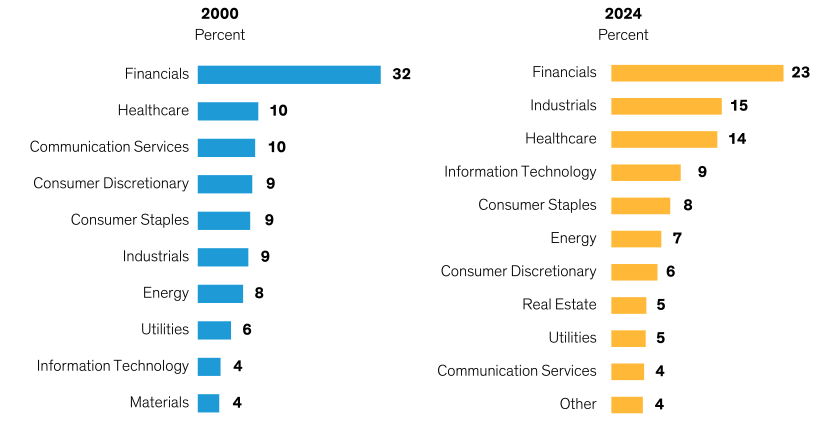
Companies like these can be found in surprising places. In 2000, financials accounted for nearly a third of the Russell 1000 Value Index, followed by healthcare, communication services and the more cyclically sensitive consumer discretionary sector. Technology stocks comprised only 4% of the value index. Nearly a quarter-century later, the weight of financials has decreased, while investors can find a larger cohort of industrials and technology stocks in the value mix (Display).
US Value Looks Very Different Today
Russell 1000 Value Sector Weights
Past performance does not guarantee future results.
As of December 31, 2024
Source: FTSE Russell and AllianceBernstein (AB)
This means the types of stocks investors can access for a value portfolio have changed too. In the past, value stocks were usually more cyclically sensitive. Today, many high-quality companies meet value criteria, with higher profitability, durable growth prospects and less sensitivity to GDP growth.
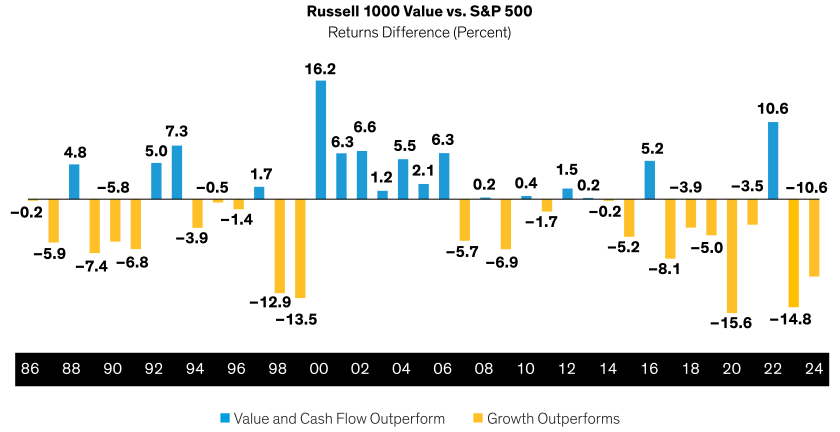
Meanwhile, the US market has become less capital intensive. As a result, the traditional way of looking at value companies, through a price/book value lens, is inadequate. Instead, we think free cash flow (FCF) metrics are a better way to pinpoint value companies that can perform in different economic conditions.
Over the last decade, value stocks with strong cash-flow yields have generally underperformed (Display). In our view, this trend will eventually revert to the mean, and attractively valued shares of companies with strong FCF will be rewarded.
Underperformance of Value and High-Cash-Flow Companies Has Been Extreme
Past performance does not guarantee future results.
Return data pre-1996 is before dividends.
Through December 31, 2024
Source: Bloomberg, FTSE Russell, S&P and AB
Choose Your Risk
Strong FCF is becoming more important for companies as the world lurches from crisis to crisis. In our view, companies with robust and consistent FCF—backed by healthy balance sheets and skilled management teams—will be more capable of adapting to surprising policy moves than their peers.
Equity investors can’t eliminate risk. But they can choose the risks they take. In today’s markets, steering clear of companies exposed to the most unpredictable risks can help portfolios avoid potential blowups from an unfavorable turn in policy. By focusing on researchable, company-specific factors, investors can build a portfolio of value stocks that is more resistant to exogenous shocks and supported by diverse sources of recovery potential.
-
References to specific securities discussed are for illustrative purposes only and are not to be considered recommendations by AllianceBernstein L.P.
-
Investment involves risk. The information contained here reflects the views of AllianceBernstein L.P. or its affiliates and sources it believes are reliable as of the date of this publication. AllianceBernstein L.P. makes no representations or warranties concerning the accuracy of any data. There is no guarantee that any projection, forecast or opinion in this material will be realized. Past performance does not guarantee future results. The views expressed here may change at any time after the date of this publication. This article is for informational purposes only and does not constitute investment advice. AllianceBernstein L.P. does not provide tax, legal or accounting advice. It does not take an investor's personal investment objectives or financial situation into account; investors should discuss their individual circumstances with appropriate professionals before making any decisions. This information should not be construed as sales or marketing material or an offer of solicitation for the purchase or sale of, any financial instrument, product or service sponsored by AllianceBernstein or its affiliates. This presentation is issued by AllianceBernstein Hong Kong Limited (聯博香港有限公司) and has not been reviewed by the Securities and Futures Commission.