-
The views expressed herein do not constitute research, investment advice or trade recommendations, do not necessarily represent the views of all AB portfolio-management teams and are subject to change over time.
How US Small-Cap Stocks Can Overcome the Market Stress Test
4 min read
Small-caps have suffered in early 2025, but increased market breadth could support a recovery.
Tariffs and trade wars have spooked investors of late. While few asset classes have been spared, US small-cap stocks have been particularly hard hit. At the same time, however, equity markets are showing signs of broadening, which could work in favor of small-caps over time.
Market turbulence can be jarring, and investors are rightly concerned about the short- and medium-term profitability of small-cap companies. Small-caps have underperformed in part because they’re perceived as being more economically sensitive than their larger-company counterparts.
Small Companies Could Be More Insulated from Trade Uncertainty
But today’s circumstances are unique. While tariffs and trade-policy uncertainty have likely slowed economic growth, the US economy is entering this period from a position of relative strength, with unemployment and inflation still low.
Trade tensions could eventually have a more significant impact on the US economy, but strong companies can still grow earnings—and may even enjoy some advantages in the evolving environment. Nearly 80% of Russell 2000 constituent revenues are generated in the US, according to Barron’s, giving small businesses greater protection from the negative effects of tariffs relative to larger-company stocks with more global exposure.
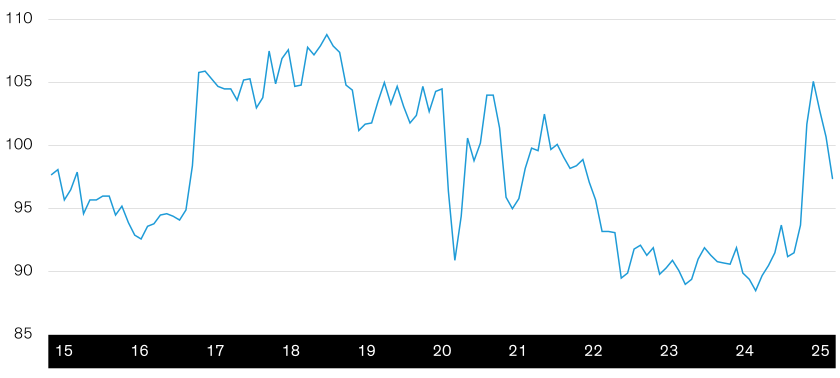
To be sure, smaller businesses are concerned about trade uncertainty, as reflected in a recent decline in the National Federation of Independent Business (NFIB) Small Business Optimism Index. Nonetheless, business optimism remains higher than it has been in the last three years (Display).
Small Business Optimism Has Declined, but It Started from a Recent High
NFIB Small Business Optimism Index
Historical analysis does not guarantee future results.
Data indexed relative to baseline (1986 = 100)
Through March 31, 2025
Source: FactSet, National Federation of Independent Business (NFIB) and AllianceBernstein (AB)
Market Broadening Could Bode Well for Small-Caps
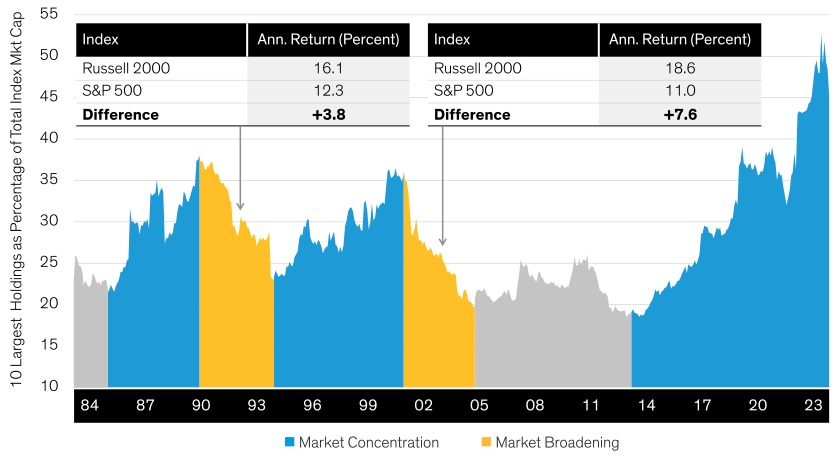
Investors in small-caps may also take solace from a broadening market. Over the last 30 years, small-cap performance has been particularly strong during the last two cycles of unwinding large-cap growth concentration—that is to say, when markets are beginning to broaden (Display). The 10 largest stocks comprised more than half the market capitalization of the Russell 1000 Growth Index by the end of 2024, marking a record high in market concentration. While this trend has shown signs of unwinding, concentration is still much higher than at previous peaks. In our view, small-caps are in a sweet spot and could benefit from declining market concentration.
Small-Caps Have Historically Outperformed When Markets Broaden
Russell 1000 Growth Index
Historical analysis does not guarantee future results.
Through March 31, 2025
Source: Bloomberg, company reports and AB
Quality Matters in Periods of Uncertainty
While broadening markets have witnessed greater small-cap returns, timing the turn can be challenging. Typically, economic recoveries—or environments with improving risk tolerance—have driven these pivots.
To capitalize on a broadening market with an uncertain beginning, we believe the best approach is to focus on higher-quality companies. High-quality stocks typically see lower drawdowns when the economy contracts and more upside when the economy expands.
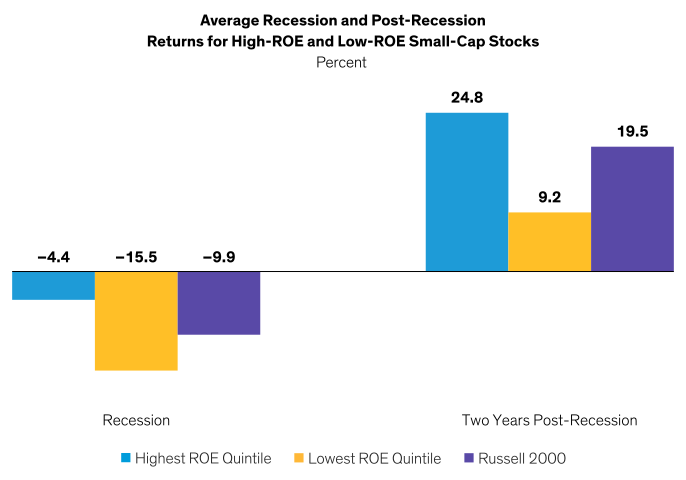
High-quality factors such as return on equity (ROE) have historically offered attractive return patterns in both good times and bad. For example, the top quintile of high-ROE small-cap stocks has been more resilient than the broader small-cap market during recessions (Display). And although low-quality factors may lead for a short period directly after recessions, our research suggests that high-ROE companies also have a track record of outperforming over the longer term as economic growth accelerates.
Quality Can Affect Performance During and After Recessions
Russell 2000 Index
Past analysis does not guarantee future results.
Recessionary periods include July 1990–March 1991, March 2001–November 2001, December 2007–June 2009 and February 2020–April 2020.
Return on equity (ROE) represents net income divided by average shareholder’s equity for the last 12 months.
Quintiles represent the highest and lowest ROE quintiles of the Russell 2000 Index.
Source: FTSE Russell, National Bureau of Economic Research and AB
The High Cost of Market Timing
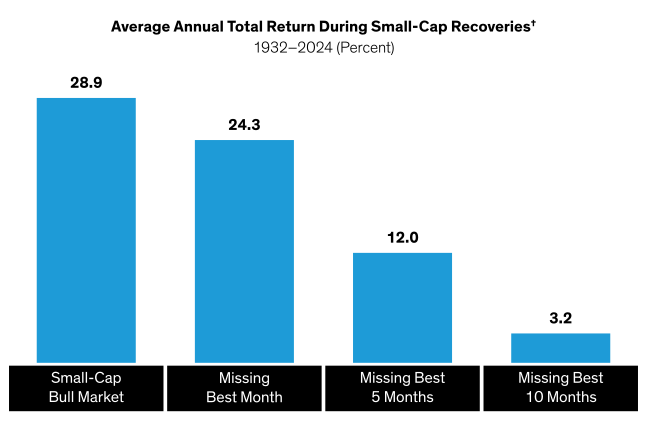
In light of recent volatility, we believe investors’ best course of action is to stay put. Attempting to time the market can have dire consequences when small-caps eventually regain momentum. In fact, missing the best five months of a small-cap bull run can cut returns by more than half, while missing the best 10 months can virtually eliminate the gains of a small-cap bull market (Display).
Missing Out on Small-Cap Recoveries Can Be Costly
US Small-Cap Stocks*
Past analysis does not guarantee future results.
*Based on the Center for Research in Security Prices (CRSP) 6–8 Index, which tracks the performance of US small-cap stocks in the sixth to eighth deciles of the CRSP stock universe
†Based on nine multiyear rallies of small-cap stocks, 1932–2024
Source: BofA Global Research, Center for Research in Security Prices (University of Chicago), FTSE Russell and AB
-
Investment involves risk. The information contained here reflects the views of AllianceBernstein L.P. or its affiliates and sources it believes are reliable as of the date of this publication. AllianceBernstein L.P. makes no representations or warranties concerning the accuracy of any data. There is no guarantee that any projection, forecast or opinion in this material will be realized. Past performance does not guarantee future results. The views expressed here may change at any time after the date of this publication. This article is for informational purposes only and does not constitute investment advice. AllianceBernstein L.P. does not provide tax, legal or accounting advice. It does not take an investor's personal investment objectives or financial situation into account; investors should discuss their individual circumstances with appropriate professionals before making any decisions. This information should not be construed as sales or marketing material or an offer of solicitation for the purchase or sale of, any financial instrument, product or service sponsored by AllianceBernstein or its affiliates. This presentation is issued by AllianceBernstein Hong Kong Limited (聯博香港有限公司) and has not been reviewed by the Securities and Futures Commission.