-
The views expressed herein do not constitute research, investment advice or trade recommendations, do not necessarily represent the views of all AB portfolio-management teams and are subject to change over time.
Healthcare Investing: Finding Growth Beyond Pharmaceuticals
4 min read
Drugmakers don’t have to dominate a healthcare portfolio. Equity investors should cast a wide net across the sector to find innovation and growth.
Pharmaceutical companies often grab the limelight in the healthcare sector. From COVID vaccines to weight-loss drugs, groundbreaking pharma products aim to cure the afflictions of humanity and improve quality of life. Investors are often enamored by the promise of a potential blockbuster drug to eradicate an intractable illness—and deliver a healthy flow of profits.
Since big pharma companies rank among the largest healthcare weights, they often dominate sector positions in a global equity portfolio or a stand-alone allocation. Yet focusing too much on pharmaceuticals could limit a portfolio’s potential. Companies that manufacture diagnostics, technology and equipment to address the world’s most pressing medical issues have become increasingly important for progress in the healthcare sector.
Changes to the healthcare benchmark over the last two decades reflect this shift. The weight of pharmaceutical companies in the MSCI World Health Care Index has fallen from 82% in 2000 to 43% today (Display). Other industries have become more prominent, offering equity investors a broader array of opportunities in areas such as life sciences tools and services, technology, and equipment.
The Healthcare Sector Looks Very Different Today
MSCI World Health Care
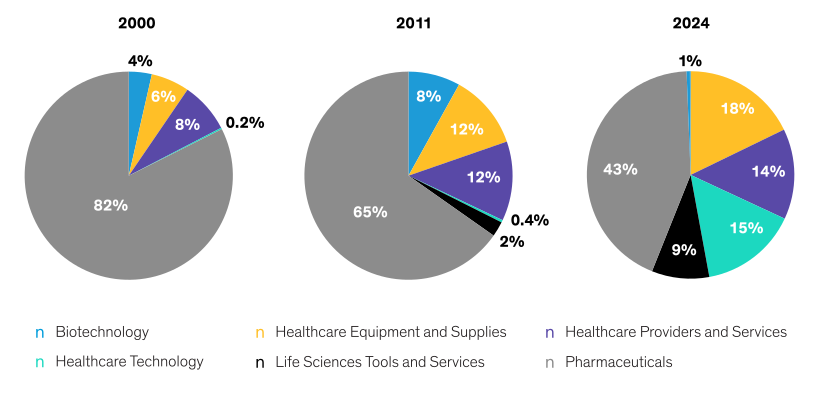
Past performance does not guarantee future results.
Numbers may not sum due to rounding.
As of December 31, 2000; December 31, 2011; and August 31, 2023
Source: MSCI and AllianceBernstein (AB)
Diagnostics and Life Sciences Tools and Services—These areas are just as important for medical processes as treatment. Advanced testing and imaging can help medical professionals detect disease at much earlier stages, improving the efficacy of treatment and chances of recovery. And the power of sequencing the human genome will unlock additional potential new drugs and help identify diseases earlier.
Waters Corporation manufactures analytical instruments for scientific research in the drug development and production processes. In the highly regulated pharmaceutical industry, the company’s strong reputation has kept customers loyal and generated recurring revenue streams that bolster its competitive advantages. There is also US-based IDEXX Laboratories, which specializes in animal diagnostics such as accurate, in-house, laboratory-level tools that deliver results for veterinarians within 10 minutes.
In biotech research and development, innovative drug-development processes are enabling new treatments that can be profitable even when addressing relatively uncommon disorders. For example, United Therapeutics manufactures a treatment for a relatively rare condition called pulmonary arterial hypertension—high blood pressure in the pulmonary artery in the lungs. It’s also been reinvesting in its organ transplant business, where it seeks to use gene editing technology that may make it easier for people to receive animal organ transplants, which are often rejected by human bodies.
Technology and Artificial lntelligence (AI)—Compared to other sectors, healthcare has been a laggard in our high-tech society. But things are changing. Companies that can successfully adopt new technology may be able to dramatically change the way care is provided and delivered—and can be found in different parts of the sector.
AI is being introduced in commercial tools by companies, including Veeva Systems of the US and GE HealthCare. As AI capabilities improve and become more widely used to diagnose diseases, we believe companies that offer software as a service for healthcare will enjoy greater demand. Veeva offers a range of software services, from clinical trials to home health monitoring to marketing software for pharmaceutical sales. GE HealthCare, a medical equipment company, is using AI in various products, for example, to improve the quality and diagnostics ability of medical imaging devices, which can lead to better patient outcomes.
Equipment and Supplies—From global drugmakers to your family doctor, the equipment and tools used to deliver healthcare products and services are constantly changing. Innovative equipment used in lifesaving procedures can improve outcomes for patients.
For surgeons, a technological revolution is rapidly unfolding. Today, an increasing number of procedures are using robotic tools that allow surgeons to access hard-to-reach spots inside the body with high-precision, minimally invasive incisions, fewer complications and faster recovery times. Intuitive Surgical of the US manufactures a robotic surgery system that is popular in US operating rooms and is gaining momentum outside the US, with significant growth opportunity in Europe, Japan and China, in our view.
Three Attributes Define Healthy Growth
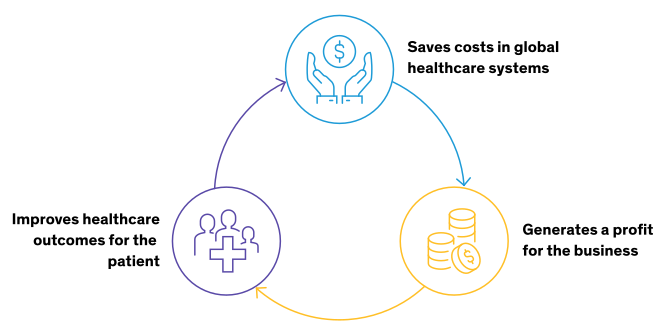
While each industry has different dynamics, we believe investors should look for three attributes to identify attractive healthcare businesses across the sector (Display).
First, look for products and services that improve healthcare outcomes for patients. Second, companies that can help cash-strapped healthcare systems save costs are likely to benefit from strong demand drivers. Third, products that improve outcomes and save costs must generate a profit for the business.
What Is a Virtuous Healthcare Ecosystem?
Source: AB
In our view, companies that possess these three attributes are operating in a virtuous ecosystem. The dynamics of a healthy ecosystem provide a foundation for companies to profitably reinvest cash flows, which helps support consistent earnings growth over time. We believe equity investors should always stay focused on business fundamentals when choosing healthcare stocks, rather than trying to predict scientific success, which is extremely hard to do.
To be sure, pharmaceutical companies that meet the criteria of a healthy ecosystem should be included in a diversified allocation of healthcare stocks. But instead of having drugmakers anchor a healthcare portfolio, the starting point should be to search for high-quality business models—wherever they may be found across the evolving spectrum of medical products and services.
-
MSCI makes no express or implied warranties or representations, and shall have no liability whatsoever with respect to any MSCI data contained herein.
The MSCI data may not be further redistributed or used as a basis for other indices or any securities or financial products. This report is not approved, reviewed or produced by MSCI.
-
References to specific securities discussed are for illustrative purposes only and should not to be considered recommendations by AllianceBernstein L.P. It should not be assumed that investments in the securities mentioned have necessarily been or will necessarily be profitable.
-
Investment involves risk. The information contained here reflects the views of AllianceBernstein L.P. or its affiliates and sources it believes are reliable as of the date of this publication. AllianceBernstein L.P. makes no representations or warranties concerning the accuracy of any data. There is no guarantee that any projection, forecast or opinion in this material will be realized. Past performance does not guarantee future results. The views expressed here may change at any time after the date of this publication. This article is for informational purposes only and does not constitute investment advice. AllianceBernstein L.P. does not provide tax, legal or accounting advice. It does not take an investor's personal investment objectives or financial situation into account; investors should discuss their individual circumstances with appropriate professionals before making any decisions. This information should not be construed as sales or marketing material or an offer of solicitation for the purchase or sale of, any financial instrument, product or service sponsored by AllianceBernstein or its affiliates. This presentation is issued by AllianceBernstein Hong Kong Limited (聯博香港有限公司) and has not been reviewed by the Securities and Futures Commission.