-
The views expressed herein do not constitute research, investment advice or trade recommendations, do not necessarily represent the views of all AB portfolio-management teams and are subject to change over time.
Emerging Markets: Finding Opportunities amid the Global Economic Reset
5 min read
US policy changes look daunting—but emerging markets still have upside.
US policy changes are triggering a global economic reset. For emerging markets (EM), that’s creating a triple whammy: higher tariffs may damage EM trade; US immigration policy will impact remittances from overseas workers to EM countries such as El Salvador and Senegal; and US spending cuts have already reduced the flow of overseas aid, hurting primarily frontier markets.
Great-power rivalry creates further problems in the reset: for many EM countries, both the US and China are big customers, and placating one without riling the other seems a near-impossible task. While the recent temporary 90-day tariff reductions have eased tensions and boosted markets, uncertainty remains high—and the underlying global-reset strategy is likely here to stay.
Meanwhile, EM exports surged early in the year as customers stockpiled ahead of potential tariff increases. That trend may continue to the end of the 90-day negotiating windows—but there will be a meaningful step-down in activity if and when the tariffs finally bite. We expect below-trend growth in EM this year, with risks evenly balanced largely depending on tariff outcomes.
Despite the array of negatives, there are some likely positives for EM from the changes too. And considering EM’s vast range of securities, coupled with a rapidly changing economic backdrop, we see several opportunities for active managers.
A Weaker Dollar Helps Emerging Markets
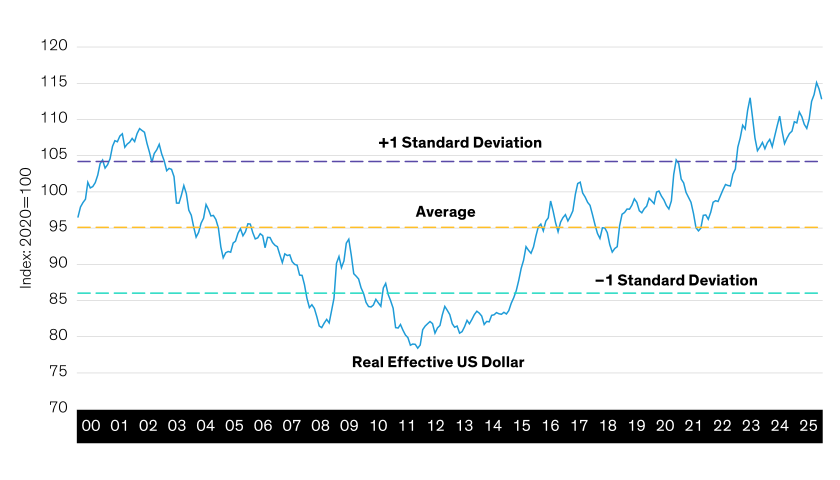
Recently the relative strength of the US economy has boosted the US dollar. But now, as investors perceive the vulnerabilities of the US economy from the proposed new tariffs, and as data suggest an incipient slowdown, the US dollar is potentially starting to roll over from a historically high level (Display).
The US Dollar Is Relatively Overvalued
Real Effective Trade-Weighted US Dollar
For illustrative purposes only. Past performance does not guarantee future results.
As of March 31, 2025
Source: Bank for International Settlements (BIS)
From a global reset perspective, a weaker dollar makes US industry more competitive, helps shrink the US trade deficit and supports the drive for reshoring and supply-chain resilience. Consequently, getting the dollar down is effectively part of the US administration’s objectives and will likely be a persistent policy focus. That could include offering tariff concessions to trading partners willing to cooperate on exchange-rate management.
We think the balance of risks already points to a weaker dollar, including: a relatively rich valuation; US policy uncertainty and debt worries; and potentially measured shifts by central bank reserve managers to diversify their currency exposures.
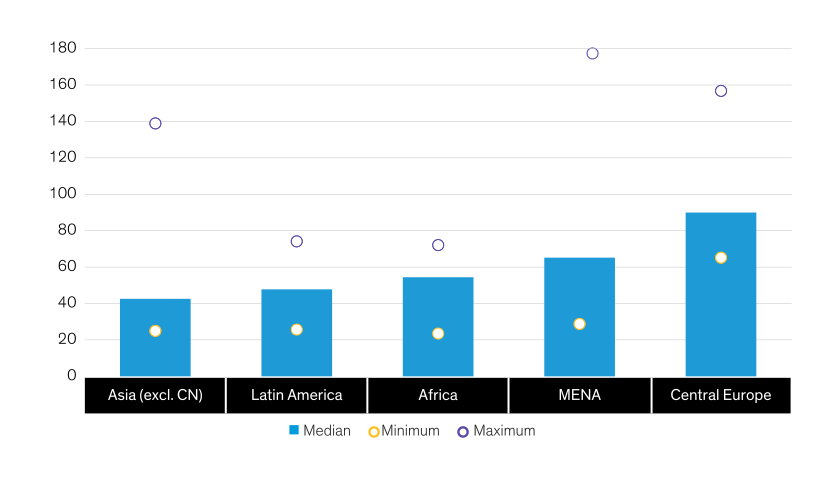
In general, a weaker dollar is positive for EM. It allows for more monetary flexibility and means less pressure for external debt repayments for EM economies. And it often coincides with higher commodity prices, which improve the balance sheets of many EM commodity exporters. A weaker US dollar can also enhance purchasing power, potentially boosting international trade. That’s a big positive, considering many EM countries have high exposure to international trade (Display).
Many Emerging-Market Countries Are Highly Exposed to International Trade
Merchandise Trade as a Percentage of GDP
For illustrative purposes only
Trade is the sum of exports and imports.
As of April 15, 2025
Source: World Bank
Emerging-Market Rebounds Have Followed Setbacks
The 2025 US tariff proposals continue the policy path first started in 2018 during the first Trump administration. EM businesses were already alert to tariff dangers and have started to adjust their supply chains to mitigate potential disruptions. Meanwhile, EM investors have factored these risks into their decision-making, and much of the anticipated impact may have already been reflected in EM securities.
Consequently we think there could be the potential for a substantial rebound in EM investments if a high-tariff scenario recedes, especially as EM equities have outperformed developed-market peers after periods of extreme market volatility.
Stay Diversified, Beware Whipsaw
Given the backdrop of high uncertainty and volatility, overly tactical investors may expose themselves to the risk of whipsaw. We favor well-diversified, balanced portfolios, with equity holdings anchored in strong fundamentals and an emphasis on pricing power and defensive characteristics that can provide resilience against tariff pressures. For bond holdings, we advocate a bias to quality (for instance, overweight to EM sovereign rather than local currency debt).
Prepare for Different Scenarios
Meanwhile, we think investors should research potential winners and losers across a range of scenarios, in anticipation of more tariff clarity. For instance:
- In a renewed high-reciprocal-tariff scenario, winners would include countries and companies that are less affected by tariffs or benefit from import substitution. We see opportunities in Brazil’s consumer and financial sectors, and in China’s consumer cyclical companies, respectively. Losers would include big exporters to the US, especially in sectors deemed most important for US manufacturing success.
- Regarding a low-tariff outcome, recent price movements have already seen a rebound in many of the worst-hit companies and countries. Thorough research should help investors understand where prices have over- or under-adjusted.
- From a global reset perspective, losers could include companies in strategically important supply chains that are vulnerable to reshoring to the US. Countries and companies involved in avoiding US tariffs by trans-shipment through third countries (“origin washing”) could also be targeted for US penalties. By contrast, winners would be companies well positioned for the planned US manufacturing revival, including those already owning or planning US operations.
Emerging Markets Offer a Vast Range of Opportunities
The sheer scale of EM companies and countries coupled with inherent market inefficiencies creates a vast range of opportunities for active managers to discover pricing anomalies, both across and within asset classes. In fact, both the median fixed-income and equity active EM investment managers have outperformed their benchmarks in the longer term. Consequently we believe that EM should command a meaningful share of investors’ active fee budgets.
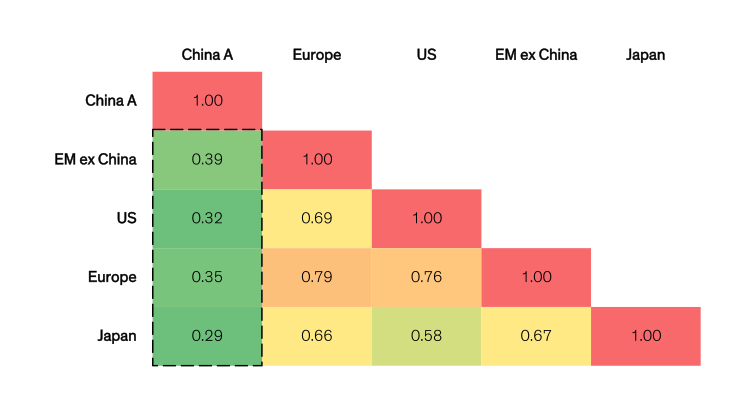
Similarly, EM may provide valuable portfolio diversification benefits during the volatile reset period. China A shares alone comprise around 5,000 stocks—a vast and less efficient market that has also exhibited some of the lowest correlations to developed markets (Display).
China A Shares Have Been Strong Diversifiers
Weekly Return Correlations, 2015 Through 2024
Past performance does not guarantee future results.
Through December 31, 2025
Source: Bloomberg
In our view, EM is well-suited for multi-asset investors, who seek the best relative value across a huge range of companies’ equity and credit securities. For example, we see a positive macroeconomic outlook for the UAE, driven by strong non-oil sector growth and healthy fiscal and current account balances. However, with debt valuations in the region remaining expensive, we favor equities tied to real estate and financials—sectors closely linked to key economic drivers but, in our view, offering superior return potential.
Time will tell how the global economic reset plays out. But we can be sure that EM will include many promising opportunities across multiple scenarios.
-
Investment involves risk. The information contained here reflects the views of AllianceBernstein L.P. or its affiliates and sources it believes are reliable as of the date of this publication. AllianceBernstein L.P. makes no representations or warranties concerning the accuracy of any data. There is no guarantee that any projection, forecast or opinion in this material will be realized. Past performance does not guarantee future results. The views expressed here may change at any time after the date of this publication. This article is for informational purposes only and does not constitute investment advice. AllianceBernstein L.P. does not provide tax, legal or accounting advice. It does not take an investor's personal investment objectives or financial situation into account; investors should discuss their individual circumstances with appropriate professionals before making any decisions. This information should not be construed as sales or marketing material or an offer of solicitation for the purchase or sale of, any financial instrument, product or service sponsored by AllianceBernstein or its affiliates. This presentation is issued by AllianceBernstein Hong Kong Limited (聯博香港有限公司) and has not been reviewed by the Securities and Futures Commission.